
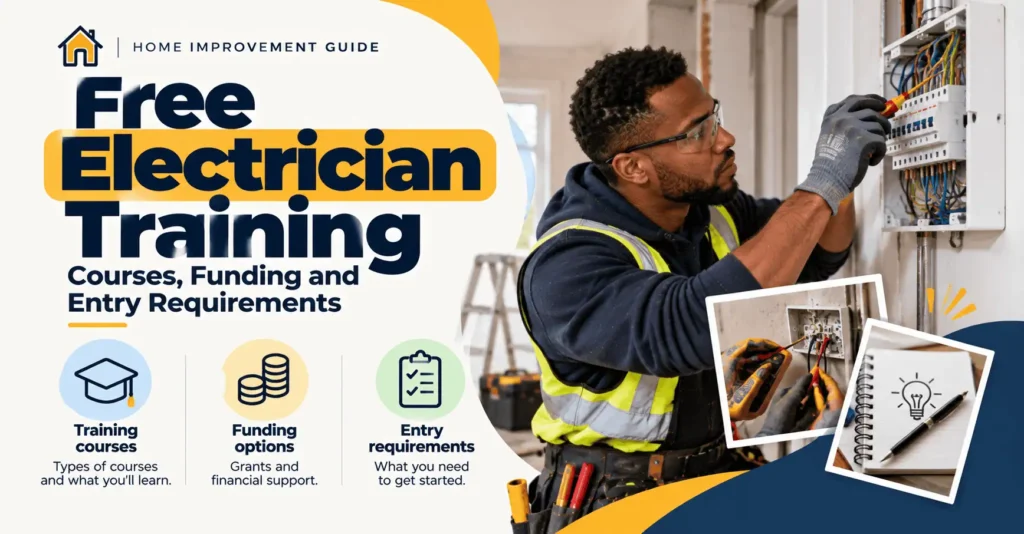
Electricians are in steady demand across the UK, and there are genuine ways to train without paying course fees. Free electrician training is available through apprenticeships, funded college courses for young people, and government-backed adult schemes such as Free Courses for Jobs and the Adult Skills Fund, depending on your age, location and existing qualifications.
To work as a fully qualified electrician you need more than a short course. This guide explains the recognised qualifications, the funded routes into electrical work, the entry requirements, and how to avoid expensive “fast-track” courses that do not lead to a recognised trade card.
What does an electrician actually do?
Electricians install, test, inspect and repair electrical systems in homes, offices, shops and industrial sites. A typical week might include wiring a new extension, replacing a consumer unit, tracing a fault that keeps tripping a circuit, fitting an EV charger or carrying out an inspection for a landlord. The work combines practical skills with careful calculations and paperwork, because every job must meet the wiring regulations and be tested and certified before it is handed over.
Funded routes compared
| Route | Who it suits | Cost to you | Length |
|---|---|---|---|
| Electrical apprenticeship | 16+, any age with an employer | No fees – you earn a wage | Around 3–4 years |
| College course (16–18) | School leavers | Usually free | 1–2 years per level |
| Adult college course (19+) | Career changers | Free or reduced if eligible | 1–2 years part-time |
| Skills Bootcamp | Adults 19+ in England | Free | Up to 16 weeks |
Skills Bootcamps are useful for related skills – for example electrical installation basics, solar PV or EV charging – but on their own they do not make you a fully qualified electrician.
The qualifications that matter
How long does it take to qualify?
Usually around 3 to 4 years, ending with the AM2 assessment and full qualification.
Level 2 and 3 courses can take 1 to 2 years part-time, followed by an NVQ gained on site.
People already working in electrical roles may complete an assessment-based NVQ more quickly.
Who can get free or funded training?
- Under 19: full-time college courses are generally free, and apprenticeship training is funded.
- Adults 19+ in England: English, maths and some Level 2 courses may be free through the Adult Skills Fund; Free Courses for Jobs funds selected Level 3 qualifications for adults earning below the threshold or unemployed.
- Unemployed or on benefits: Jobcentre Plus work coaches can sometimes refer you to funded training.
- Scotland and Wales: Modern Apprenticeships, Individual Training Accounts (Scotland) and Personal Learning Accounts (Wales) offer separate routes.
- Advanced Learner Loan: if free funding does not apply, Level 3+ fees can be covered by a loan repaid only once you earn above a threshold.
Entry requirements
Most providers look for GCSEs (or equivalent) in English and maths at grade 4/C or a willingness to study them alongside the course. Practical aptitude, good colour vision and a basic head for numbers help. Many adult learners start at Level 2 even with no previous experience.
Finding an apprenticeship as an adult
Apprenticeships are not only for school leavers. Many electrical contractors take on adult apprentices because they value reliability and life experience. To improve your chances, contact local firms directly as well as searching official apprenticeship listings, and be clear about why you want to become an electrician. Labouring or mate roles with an electrical company are another way in, as many employers later sponsor trusted staff onto formal training.
Tools and costs to plan for
Even when course fees are covered, there may be other costs. Apprentices and trainees usually need basic hand tools, safety boots and workwear, and qualified electricians eventually need a multifunction tester to certify their work. Travel to college or site can also add up. Some colleges and employers provide tool kits or help with costs, so ask what support is available before you start.
How to apply
- Explore the electrician job profile and routes on the National Careers Service.
- Contact local further education colleges about funded adult places.
- Search for apprenticeships and register with local electrical contractors.
- Ask about eligibility for Free Courses for Jobs or local Skills Bootcamps.
Career prospects after qualifying
Qualified electricians can work for contractors, housing associations, facilities management companies or as self-employed tradespeople. With experience, many specialise in areas such as inspection and testing, commercial installations, fire alarm and security systems, or low-carbon technology such as solar panels, batteries and EV chargers. These specialisms are in growing demand and can lead to higher earnings or supervisory and estimating roles.
Choosing a training provider
Look for colleges and providers approved by recognised awarding bodies, with well-equipped workshops and strong links to local employers. Ask what percentage of learners complete the course and move into jobs or apprenticeships, and whether the course includes the work placement needed for an NVQ.
Funding routes summarised from GOV.UK and National Careers Service information.
Independent guide – not linked to any college or training provider.