
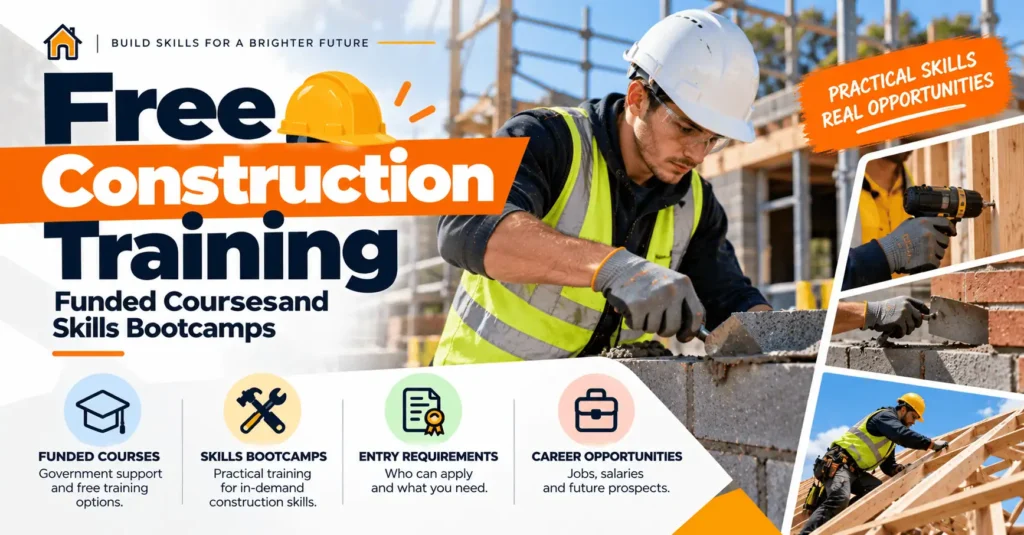
Construction is one of the easiest industries to enter through free, intensive training. In England, construction Skills Bootcamps offer free courses of up to 16 weeks for adults aged 19 and over, often with a guaranteed job interview at the end, while eligible adults without a Level 2 in building and construction can now study one free through Free Courses for Jobs.
Whether you want to work on site as a groundworker or bricklayer, operate plant machinery or move into retrofit and green construction, this guide explains the subsidised construction courses available, the CSCS card you need to get on site, and how to find a place near you.
Skills Bootcamps: the key facts
Bootcamps are open to people who are employed, self-employed, unemployed or returning to work. If an employer sends existing staff, they usually make a small contribution. You normally need the right to work in the UK and to meet residency rules.
Who are Skills Bootcamps for?
Construction bootcamps are designed for a wide range of people: school leavers over 19 who want to get on site quickly, career changers from retail, hospitality or warehouse work, people returning to work after a break, and those who are already in construction but want to move into a new trade or supervisory role. Most courses do not require previous experience, although some higher-level programmes, such as site supervision, expect some time working on site already.
Popular construction bootcamps
Course availability varies by area, as bootcamps are commissioned locally to match employer demand.
Construction roles in demand
Preparing sites, foundations, drainage and kerbs.
Building walls, extensions and new homes.
Driving excavators, dumpers and telehandlers.
Fitting plasterboard walls and ceilings.
Insulation and energy upgrades to existing homes.
Coordinating trades, safety and progress.
Getting your CSCS card
Most UK building sites require a CSCS card to prove you have the right health and safety training. For a green Labourer card you typically need:
- A Level 1 Award in Health and Safety in a Construction Environment (or equivalent).
- To pass the CITB Health, Safety and Environment test.
Many bootcamps and funded courses include both, saving you the cost. Skilled-worker cards require an NVQ or apprenticeship in your trade.
Plant operator training and cards
If you want to operate machinery, you will usually need a recognised plant competence card, such as those issued under the CPCS or NPORS schemes, for each type of machine. Some bootcamps include plant training and testing, which can otherwise cost several hundred pounds per category. Start with one machine type that is in demand locally, such as a forward tipping dumper or 360 excavator, and add more as you gain experience.
Other free or funded routes
- Free Level 2 in building and construction: for adults 19+ in England who do not already hold one.
- Construction apprenticeships: paid training in trades such as bricklaying, carpentry and plastering.
- Sector-based work academies: short training plus a work placement and interview, arranged through Jobcentre Plus.
- CITB funding: employers registered with CITB can claim grants towards training their staff.
What a typical week looks like
| Day | Example activity |
|---|---|
| Monday | Health and safety theory |
| Tuesday–Wednesday | Practical workshop skills |
| Thursday | Site visit or employer session |
| Friday | CV, interview preparation and assessment |
What to expect on your first site
New starters normally begin as labourers or trainees, helping skilled workers, keeping the site tidy and moving materials safely. Days often start early, and sites expect punctuality, the right personal protective equipment and a positive attitude. You will attend a site induction covering safety rules and emergency procedures. Asking questions and showing willingness to learn is the fastest way to be trusted with more skilled work.
Progressing after a bootcamp
A bootcamp is a starting point rather than the end of your training. After gaining site experience, many people move onto an NVQ Level 2 in their trade, which is assessed on the job and leads to a blue skilled worker CSCS card. Others start a construction apprenticeship or take further short courses in areas such as scaffolding, first aid or working at height. Keep records of everything you complete, as they help when applying for new roles.
Help with travel, childcare and equipment
Some bootcamp providers and colleges can help with travel costs, childcare or basic equipment such as boots and hi-vis clothing, especially for people on low incomes or claiming benefits. Jobcentre Plus may also be able to help with costs linked to starting work. Ask about this support when you apply, because it can make the difference between being able to take a place or not.
Tips for securing a place
Information based on Department for Education and GOV.UK guidance.
Independent guide – not linked to any training provider.