
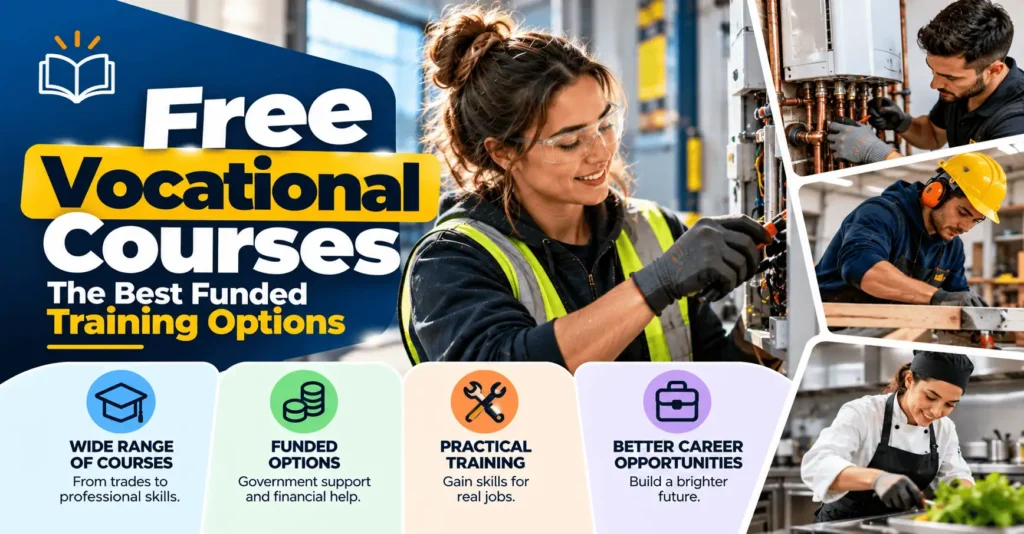
Learning a practical trade or new professional skill does not have to mean large course fees. The UK has a range of free vocational courses and subsidised training for adults, from paid apprenticeships to Skills Bootcamps, Free Courses for Jobs and funded English, maths and digital courses. The challenge is knowing which one you qualify for.
Below are the best funded training options, a quick guide to match them to your situation, and the steps to check your eligibility and apply.
The best funded options
Popular vocational subjects
Trade and technical subjects are particularly well supported because employers report shortages of skilled workers. Courses linked to construction, engineering and low-carbon energy are often among the first to receive extra funding.
Which option fits you?
| Your situation | Best starting point |
|---|---|
| Want to earn while you learn a trade | Apprenticeship |
| Need new skills quickly to change job | Skills Bootcamp |
| Low income, no Level 3 qualification | Free Courses for Jobs |
| Unemployed and claiming benefits | Work coach referral, Adult Skills Fund or work academy |
| Free funding does not apply, Level 3+ | Advanced Learner Loan |
Understanding qualification levels
Vocational qualifications in England, Wales and Northern Ireland are grouped by level. Level 1 is introductory, Level 2 is broadly equal to GCSEs at grades 4 to 9 and is often the minimum for skilled entry roles, and Level 3 is equivalent to A levels and usually needed for fully qualified trade or technician jobs. Levels 4 and 5 cover higher technical and supervisory roles. Scotland uses its own framework, but courses are designed to match similar standards. Knowing your current level helps you work out which free funding applies.
Scotland, Wales and Northern Ireland
- Scotland: Modern Apprenticeships and Individual Training Accounts for eligible adults, through Skills Development Scotland.
- Wales: Personal Learning Accounts offer free, flexible courses for employed adults, alongside apprenticeships.
- Northern Ireland: ApprenticeshipsNI and Skills Focus programmes through local further education colleges.
How to check your eligibility
- Note your highest qualification and current annual earnings.
- Confirm your right to work and how long you have lived in the UK.
- Search courses on official government and college websites.
- Contact the college or provider – they make the final funding decision.
- Have ID, proof of address and, if relevant, proof of income or benefits ready.
Balancing training with work and family
Many funded courses are offered part-time, in the evenings, at weekends or through blended online and classroom learning. Skills Bootcamps in particular are designed to fit around existing jobs and caring responsibilities. Before enrolling, ask about timetables, how many hours of study are expected each week and whether attendance can be flexible if your shifts change. Some providers also offer help with childcare or travel for eligible learners.
Benefits and training
If you receive Universal Credit or other benefits, speak to your work coach before starting a course. Many types of training are encouraged and can count towards your job search commitments, and work coaches can sometimes refer you to funded places or short work-focused programmes. Agreeing your plans in advance avoids problems with your claim.
Recognition of prior learning
If you already have experience in a trade but no formal qualification, ask about recognition of prior learning or experienced worker assessment routes. These let you prove existing skills through workplace evidence and practical tests, rather than repeating training you do not need. They can save months of study and help you reach a recognised qualification more quickly.
Spotting a good course
Choose courses that lead to a recognised qualification from an awarding body such as City & Guilds, NOCN or Pearson, or that are run in partnership with employers. Be wary of “free” online courses that charge for certificates, or providers asking for personal bank details before enrolment.
What happens after the course?
The best courses have a clear next step. A Skills Bootcamp usually offers a guaranteed interview; a Level 2 course may lead onto Level 3 or an apprenticeship; and a Level 3 qualification can open the door to skilled jobs or further technical study. Ask providers about their progression rates – how many learners move into work or further study – and which employers they work with. A course with strong local employer links is often worth more than one that simply issues a certificate.
Funding details based on Department for Education and GOV.UK guidance.
Independent guide – not linked to any college or training provider.