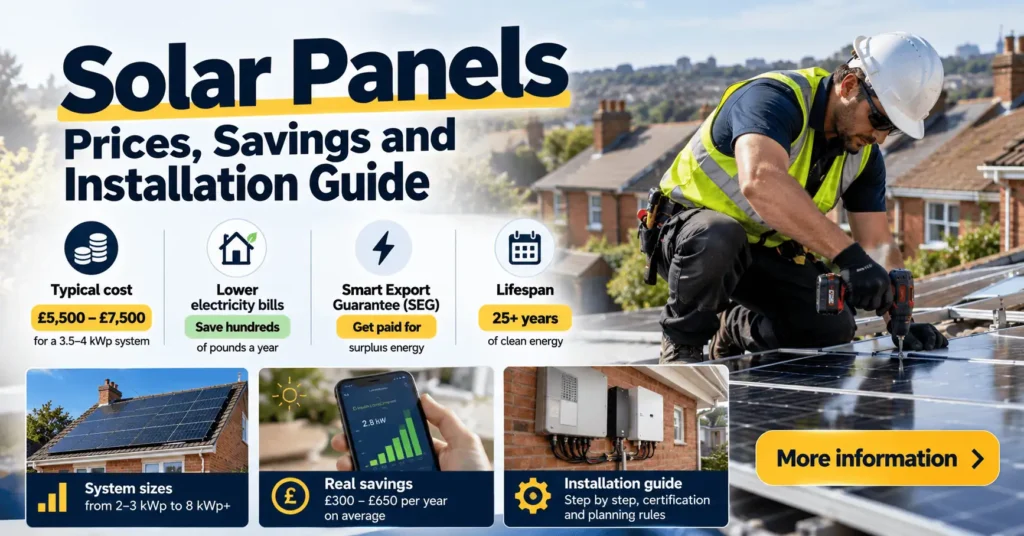
If you are thinking about solar panels for your home, the first questions are usually the same: how much do solar panels cost in the UK, how much could they save on your electricity bills, and is the installation worth the upfront spend? A typical 3.5–4 kWp solar PV system for a three-bedroom house generally costs in the region of £5,500 to £7,500 fitted, including panels, inverter, scaffolding and labour, although your final quote will depend on your roof, location and installer.
Heat Pumps: Installation, Grants and Running Costs →
You will stay on this website.
Savings come from two places: the electricity you use directly from your panels instead of buying it from the grid, and the payments you receive for surplus power exported through the Smart Export Guarantee (SEG). Depending on how much electricity you use during daylight hours, a typical household can cut its costs by several hundred pounds a year, and adding a solar battery can push that figure higher by storing daytime generation for the evening.
This guide explains solar panel prices by system size, the extra costs that are not always obvious in a quote, realistic payback periods, planning permission and MCS certification, the grants available to eligible households and the step-by-step installation process – so you can compare quotes with confidence and avoid overpaying.
Solar panel prices in the UK by system size
Installers price solar mainly by system size in kilowatt-peak (kWp) – the maximum output of the panels in ideal conditions. Larger systems cost more in total but usually less per kWp, because scaffolding, the inverter and labour are shared across more panels.
| System size | Approx. panels | Usually suits | Typical installed price |
|---|---|---|---|
| 2–3 kWp | 5–7 | Smaller homes, limited roof space | £4,000–£5,500 |
| 3.5–4 kWp | 8–10 | Typical three-bedroom house | £5,500–£7,500 |
| 5–6 kWp | 12–14 | Larger homes, EV or heat pump owners | £7,500–£10,000 |
| 8 kWp and above | 18+ | Large properties with high usage | £11,000+ |
Prices are for on-roof panels on a standard pitched roof. In-roof (integrated) systems and solar roof tiles cost noticeably more.
Extra costs worth budgeting for
A low headline price can look attractive until the extras appear. Ask every installer to itemise the following, so you are comparing like with like:
- Scaffolding: often included, but if listed separately it commonly adds £500–£1,200, more for tall or awkward properties.
- Bird protection mesh: stops pigeons nesting under panels; typically £300–£600 when fitted with the system.
- Power optimisers: useful on partly shaded roofs; usually charged per panel.
- Solar battery: the Energy Saving Trust puts typical battery storage at £5,000–£8,000, though it is often cheaper when installed at the same time as the panels.
- Hot water diverter: sends surplus electricity to your immersion heater; budget roughly £800.
- Consumer unit upgrade: older fuse boards may need replacing before the system can be connected.
- Inverter replacement: panels last decades, but most string inverters need replacing once during the system’s life.
How much can solar panels save?
Your savings depend less on the panels themselves and more on when you use electricity. Every unit you use straight from the roof is a unit you do not buy at full retail price, while exported units earn a lower SEG rate. For a typical system, combined bill savings and export income are commonly estimated at around £300 to £650 a year, giving a payback period of roughly 8 to 14 years on a system expected to run for 25 years or more.
Roof direction matters too. South-facing roofs perform best; according to the Energy Saving Trust, east- or west-facing systems typically produce around 15–20% less, and north-facing roofs are generally not recommended. Shading from chimneys, trees or neighbouring buildings can reduce output further.
The Smart Export Guarantee explained
The Smart Export Guarantee requires larger electricity suppliers in England, Scotland and Wales to pay small-scale generators for electricity exported to the grid. You do not have to use the same company for your import and export tariffs, and rates vary widely between suppliers, so it pays to compare. To apply you will normally need:
- An MCS certificate (or an accepted equivalent such as Flexi-Orb) for the installation and installer.
- A smart meter able to record half-hourly export readings.
- Proof that you own the system and details of your meter.
Grants and help with the cost
Most homeowners pay for solar privately, but a few measures reduce the bill. Eligible residential installations of solar panels and batteries currently benefit from 0% VAT. In England, the Warm Homes: Local Grant, delivered by councils, can fund upgrades – sometimes including solar panels – for low-income households, generally those with a household income of £36,000 or less or on certain benefits, living in a home with an EPC rating of D to G. Solar is one possible measure, not an automatic entitlement. Scotland, Wales and Northern Ireland run their own support schemes.
Do you need planning permission?
In England, panels fitted to the roof of a house are usually permitted development, meaning no planning application is needed, provided certain limits are met. Exceptions include listed buildings, some properties in protected areas and flats, and leaseholders or tenants need permission from the freeholder or landlord. Rules differ in Scotland, Wales and Northern Ireland, so check the Planning Portal or your local council before signing a contract. Your installer should also notify your local network operator (DNO) and handle the electrical certification.
The installation process step by step
- Survey and design: the installer checks your roof, shading, fuse board and usage, then designs the system and models expected output.
- Quote and paperwork: you receive a written quote, performance estimate and contract. Larger systems may need DNO approval before work starts.
- Scaffolding: usually erected a day or two before fitting.
- Fitting: mounting rails, panels, inverter and wiring are installed – typically one to two days for a standard home.
- Commissioning and handover: the system is tested, and you should receive your MCS certificate, electrical certificate, warranties and monitoring app details.
- SEG registration: you apply to your chosen supplier using your MCS certificate number.
How to compare quotes
Get at least three written quotes from MCS-certified installers who belong to a consumer code such as RECC or HIES. Compare total price, panel and inverter brands, warranties, expected annual generation (kWh) and what extras are included. Treat the following as red flags: pressure to sign on the day, large upfront deposits, savings described as “guaranteed”, and quotes with no performance estimate.
Frequently asked questions
Do solar panels work on cloudy days?
Yes. Panels generate from daylight, not direct sunshine, so they still produce power on overcast days – just less than in bright conditions. Output is highest from late spring to late summer.
Do I need a battery?
Not necessarily. A battery raises the share of solar power you use yourself, which suits households that are out during the day, but it adds significantly to the cost. Many people start with panels and add a battery later.
Can panels go on a flat roof?
Yes. Panels are mounted on angled frames, often weighted rather than drilled, and can be positioned to face south even if the building does not.
How much maintenance do they need?
Very little. Rain usually keeps panels clean; occasional checks of the inverter display or app will show if output drops unexpectedly.
Will solar panels affect my home insurance or mortgage?
Tell your insurer before installation, as panels add value to the building. If you own the system outright it rarely causes mortgage problems; leased “rent-a-roof” arrangements can complicate a sale.
Figures based on Energy Saving Trust, Ofgem and GOV.UK data.
Independent guide – not linked to any installer or energy supplier.

